

What Is Corrugated Cardboard and How Is It Made?

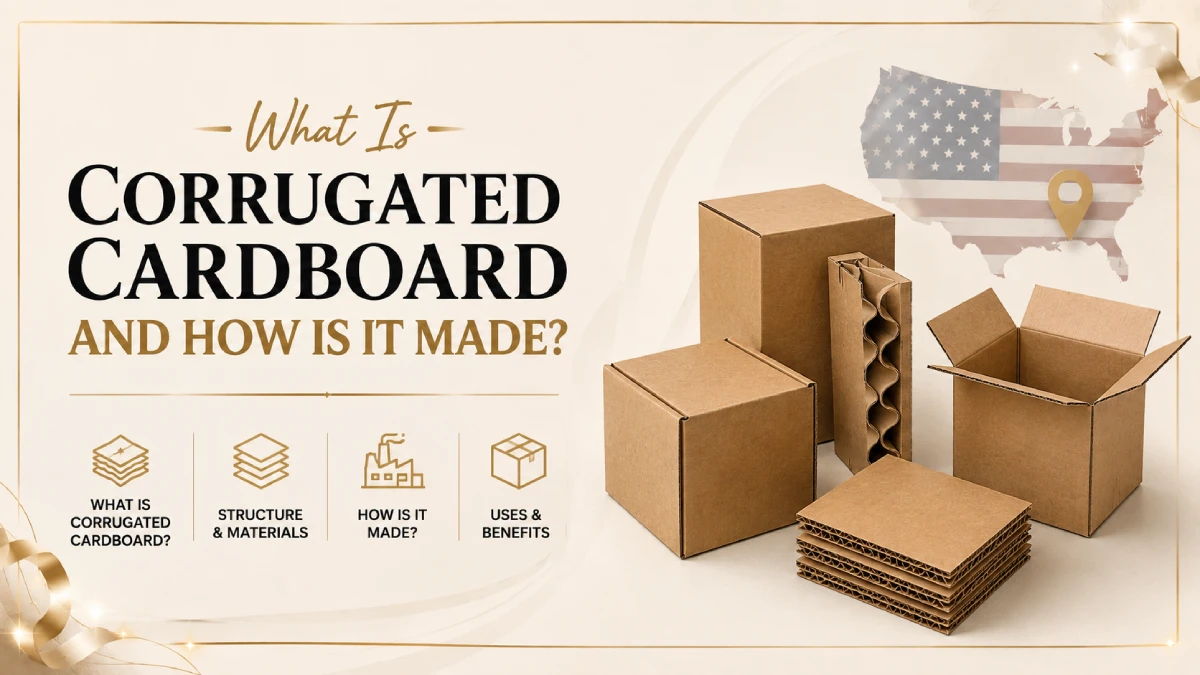
Walk into any warehouse, fulfillment center, or retail stockroom in America and you will find the same material stacked floor to ceiling: corrugated cardboard. It ships billions of products every year from Asia to America. It protects everything from smartphones to fresh produce, and serves as the blank canvas for some of the most recognizable brand packaging in the country. Yet most business owners ordering custom boxes for the first time have never stopped to ask what corrugated cardboard actually is, how it works, or why it performs so differently from the flat cardboard used in cereal boxes and greeting cards.
This guide answers all of it. It delivers from the basic structure and manufacturing process to flute types, strength ratings, sustainability credentials, and how to choose the right corrugated packaging for your product and shipping needs in the USA.
What Is Corrugated Cardboard Made of?
Corrugated cardboard is a multi-layer packaging material constructed from two primary components. One is linerboard and the other is fluting that is also called the medium. These two elements are combined using heat, steam, and adhesive to create a sandwich structure that is dramatically stronger and more rigid than any of its individual layers.
Linerboard
It is the flat, smooth paper sheet that forms the outer and inner faces of the corrugated board. It is what you see and touch on the outside of a shipping box. Linerboard is typically made from kraft paper — a strong, coarse paper produced from virgin wood pulp or recycled fiber. In the USA, most commercial linerboard contains a significant percentage of recycled content, with many grades running at 70–100% post-consumer recycled fiber.
Fluting
It is the wavy, arched paper layer sandwiched between the linerboards. This is the component that gives corrugated its structural strength. The arched shape of the fluting works exactly like an arch in architecture — distributing weight and pressure across the entire surface rather than concentrating it at a single point. The fluting is produced by passing paperboard through heated rollers that press the characteristic wave pattern into the material before it is bonded to the liner sheets.
How Corrugated Cardboard Is Made: Process to Understand
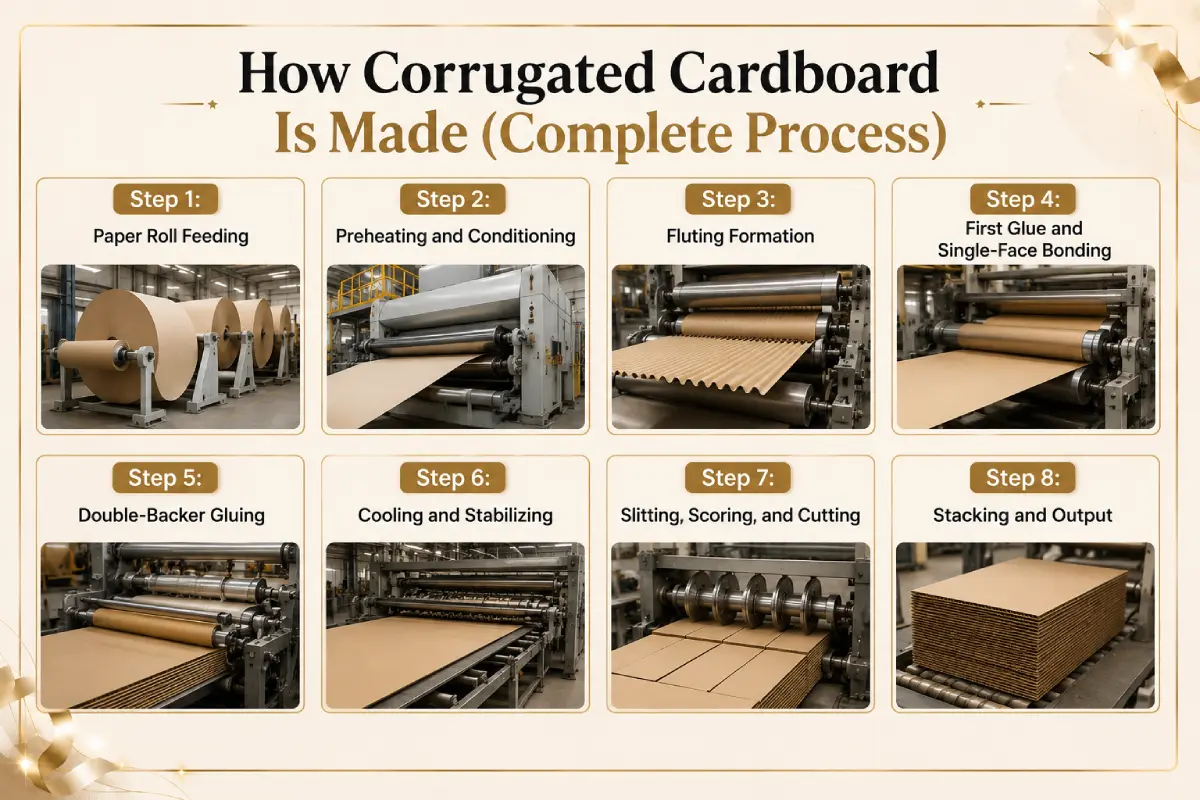
Corrugated cardboard production is a continuous process using massive machines called corrugators to turn paper rolls into strong, wavy sheets.
1. Paper Roll Feeding
Workers load giant rolls of linerboard (flat outer layers) and fluting medium (inner wavy paper) onto the corrugator machine. These rolls can weigh tons and unwind automatically as production starts.
2. Preheating and Conditioning
The paper passes over steam-heated cylinders to reach about 200°C and optimal moisture (8-12%). This softens fibers for shaping without cracking and helps glue stick later.
3. Fluting Formation
Fluting medium feeds between grooved, heated rollers that press it into a wave pattern (flutes like A, B, C, or E sizes for strength). This creates the core structure.
4. First Glue and Single-Face Bonding
Starch-based glue applies to flute tips via a roller. A flat linerboard presses onto one side in the “single facer” section, forming a web held by pressure belts.
5. Double-Backer Gluing
The single-face web moves to the double-backer. Glue goes on the exposed flute tips, and the second linerboard bonds under heat belts (up to 150m/min speed).
6. Cooling and Stabilizing
Hot board passes through cooling sections to set the glue, reduce stress, and firm up the sheet for cutting.
7. Slitting, Scoring, and Cutting
Rotary knives slit the wide sheet to narrow widths, score fold lines (parallel to flutes), and cut it into precise sheets (e.g., for box blanks).
8. Stacking and Output
Sheets stack automatically (up to 100+ per bundle), get counted, and move to storage or box-making lines for printing, folding, and gluing into final boxes.
In the manufacturing unit of LRP, we do not compromised on the materials we used for Corrugated shipping boxes, because our first priority is to satisfy our customers by delivering quality product at competitive prices.
Why Corrugated Cardboard Is Strong
The strength of corrugated cardboard comes entirely from its geometry. The fluted arches between the linerboards act as a series of columns, each one capable of bearing significant compressive load. When stacked in the same direction as the flutes, corrugated boxes can support weights many times greater than the weight of the board material itself.
Two standardized tests measure corrugated strength in the USA:
Edge Crush Test (ECT) measures how much force the corrugated board can withstand when compressed from the top edge downward, the same direction that stacked boxes in a warehouse or shipping container experience pressure. ECT is the most relevant strength rating for shipping applications and is expressed in pounds per linear inch (PLI). A higher ECT number means the box can be stacked higher without collapsing.
Burst Strength (Mullen Test) measures how much pressure the board can withstand before rupturing. While this test has been the traditional industry standard for decades, ECT has become the preferred measurement for most modern U.S. shipping and e-commerce applications because it more accurately reflects real-world stacking conditions.
Moisture is the primary enemy of corrugated strength. Corrugated boxes lose a significant portion of their stacking strength when exposed to high humidity. A relevant concern for refrigerated shipping, outdoor storage, and humid climates. Moisture-resistant coatings and wax treatments are available for applications where this is a concern.
Corrugated Cardboard vs Regular Cardboard
This is one of the most common questions in packaging, and the distinction matters enormously when choosing materials for your product.
Regular cardboard
It is technically called paperboard or chipboard. This type of regular cardboard is a single, solid layer of compressed paper fiber. It is what makes up cereal boxes, shoe boxes, cosmetic packaging, and greeting cards. It is lightweight, easy to fold and print on, and cost-effective for retail packaging of products that do not require heavy protection.
Corrugated cardboard
It is a multi-layer structure with a fluted core. It is significantly thicker, stronger, and more resistant to impact and compression. It is the standard material for shipping boxes, outer cartons, and any packaging that needs to protect products through a fulfillment and delivery chain.
The Rule of thumb
If your product ships in a box from a warehouse to a customer’s door, it needs corrugated. If it sits on a retail shelf in a display box, paperboard may be sufficient. Many brands use both a corrugated shipping outer and a paperboard inner retail box to balance protection with presentation.
Types of Corrugated Cardboard for Choosing the Right One
Not all corrugated cardboard is the same. Flute size and wall construction determine how a box performs under real-world conditions, and choosing the right configuration is one of the most important decisions in custom packaging.
Corrugated Cardboard on the Base of Flute Type
Flute Types are categorized by the size and frequency of the arched wave pattern:
- A-Flute is the largest flute size, offering maximum cushioning and vertical compression strength. It is ideal for fragile or heavy products that need significant impact protection during shipping.
- B-Flute is thinner and denser than A-flute, with more arches per linear foot. It offers good puncture resistance and a flatter surface for printing. B-flute is widely used for canned goods packaging, retail display boxes, and point-of-purchase displays.
- C-Flute is the most commonly used flute size in the USA. It balances stacking strength, cushioning, and printability, making it the default choice for standard shipping boxes across virtually every product category.
- E-Flute is very thin — often used as a replacement for rigid paperboard in premium retail packaging and cosmetic boxes. Its fine, dense structure provides an exceptionally smooth printing surface while offering more protection than standard paperboard.
Types on the Basis of Wall Configurations
Wall Configurations describe how many layers of linerboard and fluting are combined:
- Single-wall corrugated consists of one fluted medium bonded between two linerboards. This is the standard configuration for most shipping boxes and accounts for the majority of corrugated production in the USA.
- Double-wall corrugated adds a second fluted medium and a third linerboard, creating a significantly stronger and more rigid structure. Used for heavy products, international shipping, and industrial applications.
- Triple-wall corrugated is the heaviest-duty option, used for extremely heavy or high-value products, bulk shipments, and applications where wooden crates were previously required.
What Is Corrugated Cardboard Used For?
Corrugated cardboard is the backbone of product distribution in the USA. Its applications span virtually every industry and product category.
- In e-commerce, corrugated shipping boxes protect products from warehouse to doorstep. The explosion of online shopping has made corrugated the single fastest-growing packaging category in the U.S. market.
- In food and beverage, corrugated trays, cases, and containers transport produce, beverages, frozen foods, and bakery products through cold chain and ambient distribution. Food-grade corrugated packaging meets FDA contact standards for direct food contact applications.
- In retail, corrugated display units — shelf-ready packaging and point-of-purchase displays — are used by brands to present products on store floors without requiring unpacking by retail staff.
- In industrial and manufacturing, heavy-duty corrugated replaces wooden crating for machinery parts, automotive components, and bulk goods shipments across the USA and internationally.
Benefits of Custom Corrugated Boxes for Businesses
Custom corrugated packaging does more than protect your product. For brands selling through e-commerce, wholesale, or retail channels in the USA, it is one of the most cost-effective brand-building investments available.
A branded corrugated box is the first physical interaction a customer has with your product. Before the item is opened, before the product is experienced, the box communicates your brand values, quality level, and attention to detail. Unboxing content across social platforms has made this moment commercially significant in ways that were not measurable a decade ago.
Beyond branding, custom sizing eliminates the dimensional weight penalties that come with standard oversized boxes. A box engineered precisely for your product reduces void fill, lowers DIM weight charges from UPS and FedEx, and decreases material cost per unit, savings that compound significantly at volume.
Custom corrugated also allows for structural design elements that protect specific product shapes, incorporate inserts and dividers, and meet the exact drop-test requirements for your product category and shipping method.
How to Choose the Right Corrugated Packaging
Selecting the right corrugated box begins with four questions:
- What is the product’s weight?
- What are its fragility requirements?
- What is the shipping environment?
- What are the branding and presentation requirements?
For lightweight products under 20 lbs with standard fragility, single-wall C-flute is almost always the correct choice. For heavier or more fragile products, move to double-wall or specify a higher ECT rating. For products that require a premium unboxing experience at retail, E-flute with full-color printing delivers a high-end result at a practical price point.
Always specify whether you need inner or outer dimensions, and confirm with your supplier whether their quoted dimensions are for the box in flat or assembled form. Matching your box dimensions correctly to your product — with appropriate clearance for void fill or inserts — is the most important structural decision in the design process.
Sustainable Corrugated Packaging in the USA
Corrugated cardboard is one of the most sustainable packaging materials available in the USA. The corrugated industry maintains a recycling rate consistently above 90%. It is higher than almost any other packaging material in the country. Used corrugated boxes are collected, repulped, and converted back into new linerboard and fluting in a genuinely circular system.
FSC-certified corrugated packaging, produced from responsibly managed forest sources, is widely available from U.S. suppliers and is increasingly required by major retail buyers and corporate sustainability programs. Many XR Packaging corrugated products are available with FSC certification and post-consumer recycled content documentation for brands reporting on their packaging sustainability commitments.
How LRP (Little Rock) Packaging Can Help
At LRP Packaging, we work with brands of all sizes across the USA, from early-stage e-commerce sellers placing their first custom order to established manufacturers ordering at scale, to develop corrugated packaging that protects products, strengthens brands, and controls logistics costs.
Our team provides structural design consultation to identify the right flute, wall configuration, and ECT rating for your product and shipping requirements. We offer full-color custom printing directly on corrugated surfaces, with options for matte, gloss, and specialty finishes. Low MOQ options make custom corrugated accessible for small businesses without warehouse-scale order commitments, and our U.S.-based production and fulfillment infrastructure means faster turnaround times than overseas alternatives.
Whether you are packaging a fragile skincare product for DTC e-commerce, designing a shelf-ready retail display for a national retailer, or sourcing heavy-duty corrugated for industrial shipments, LRR Packaging has the materials, capabilities, and experience to deliver.
Frequently Asked Questions
Q: What is corrugated cardboard?
Corrugated cardboard is a strong, lightweight packaging material with wavy ridges (flutes) sandwiched between flat layers of paper. It is commonly used for boxes, shipping packages, and product protection. The air pockets in the middle make it cushioning and sturdy.
Q: What are the main components of corrugated cardboard?
It has three main parts: two flat sheets called liners on the outside, and one wavy middle layer called the flute or corrugating medium. These are glued together. Sometimes it has more layers for extra strength.
Q: How is corrugated cardboard manufactured?
Large rolls of paper are heated and shaped into wavy flutes. Glue is applied, and flat liner sheets are pressed onto both sides of the wavy layer. The sheets are then cut and folded into boxes.
Q: What are the different types of corrugated cardboard and their uses?
Single-wall (one wavy layer) is used for regular shipping boxes. Double-wall (two wavy layers) is stronger for heavy items. Triple-wall is very strong and used for industrial shipping and big machinery.
Q: What are the advantages of using corrugated cardboard for packaging?
It is cheap, lightweight, and very strong for its weight. It protects items from bumps and is easy to print on. Most importantly, it is recyclable and biodegradable.
Q: Can corrugated cardboard be recycled and how?
Yes, it is highly recyclable. Just break down the boxes, remove any tape or plastic, and put them in your recycling bin. Factories clean and turn old cardboard into new paper and boxes.
Q: Is corrugated cardboard the same as cardboard?
No. Regular cardboard is a single solid layer. Corrugated cardboard has a fluted core bonded between flat linerboards, making it significantly stronger and better suited for shipping.
Q: What flute type is best for shipping fragile items?
A-flute or double-wall C-flute provides the best cushioning for fragile products. For lightweight fragile items, E-flute offers a good balance of protection and printability.
Q: Is corrugated cardboard recyclable in the USA?
Yes. Corrugated cardboard has one of the highest recycling rates of any material in the USA, consistently above 90%.
Q: What is the minimum order quantity for custom corrugated boxes at LRP Packaging?
MOQ varies by box size and configuration. Contact our team for a quote tailored to your volume and specifications.
Q: How long does it take to produce custom corrugated boxes?
Standard lead times for custom corrugated printing run 10–15 business days. Rush production options are available for time-sensitive orders.
Q: How is corrugated cardboard made?
Paper rolls are fed into a machine that makes the middle layer wavy. Glue sticks the wavy layer between two flat sheets. The material is then cut, scored, and folded into boxes. The whole process is fast and done in big factories.
Q: Why is corrugated cardboard strong?
The wavy middle layer (flutes) acts like tiny I-beams that give strength and keep the box from collapsing. The air spaces inside also absorb shocks. This structure makes it much stronger than regular flat cardboard.
Q: How does the corrugation process work?
Hot steam softens the paper. Gears with teeth press the paper into permanent wavy shapes (flutes). Glue is added to the tips of the waves, and flat paper is pressed on top to lock everything together.
Q: When was corrugated cardboard invented?
It was invented in the 1870s in the United States. The first patent was in 1871 by Albert Jones for single-faced corrugated paper. By the early 1900s, it became popular for shipping boxes.