

Blogs
How to Write Dimensions for Packaging Boxes and Design – LRP

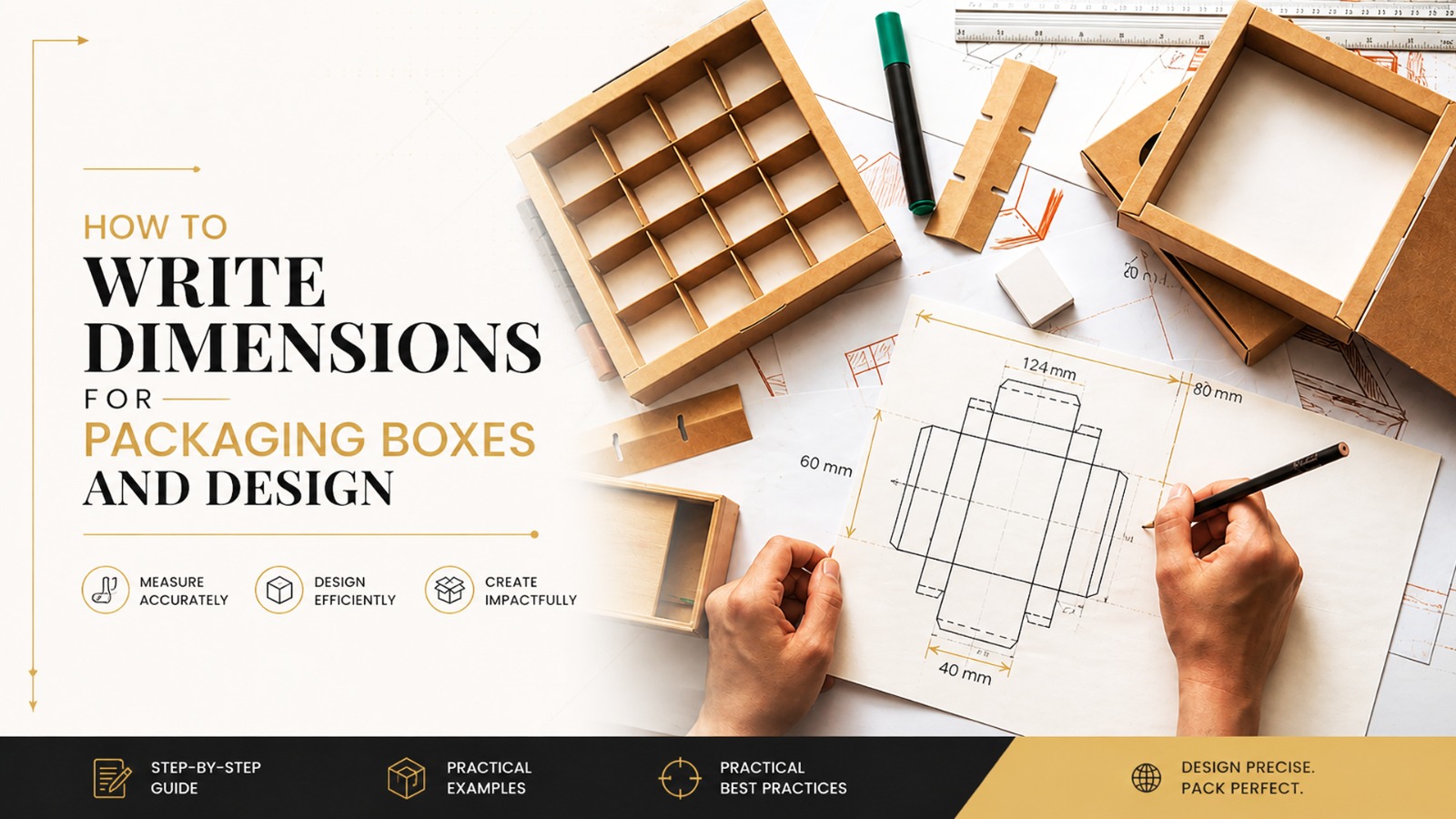
If you’ve ever stared at a box spec sheet and wondered whether the first number is the length or the height, you’re not alone. Packaging dimensions confuse beginners and experienced brand owners alike. Getting them wrong costs real money in misprinted boxes, rejected shipments, and wasted materials. At Little Rock Packaging, we work closely with the top brands across the USA every day. Dimension errors are among the most common problems we see before a print run goes out but most are avoidable.
Key Takeaways
This experts guide has been written by Little Rock Packaging experts team and reviewed by the UMR (Product designer), who has expertise of custom packaging since 2017. This guide covers everything:
- The correct order for writing dimensions and how to read it accurately.
- How to measure a box dimension accurately.
- What U.S. shipping carrier rules applied for measuring the correct dimension
- What are the dimensional weight and dieline specs for printing.
- Common mistakes that quietly derail packaging projects before they even start.
In the end you have proper answers for the common queries related to packaging dimensions.
What Are Packaging Dimensions?
Packaging dimensions are the three measurements that define the physical size of a box or container: its length, width, and height. Every decision about packaging, from the number of units that can fit on a pallet to the much it costs to ship with FedEx comes from the three figures. Making them clear in the initial design phase will prevent costly mistakes at each stage that is followed.
Dimensions also act as a link that connects your item to packaging vendor. If you provide specifications to a printing firm that custom prints such as Little Rock Packaging, dimensions communicate exactly what you want, without confusion, no back and forth or printing reprints.
How to Write Dimension Length × Width × Height
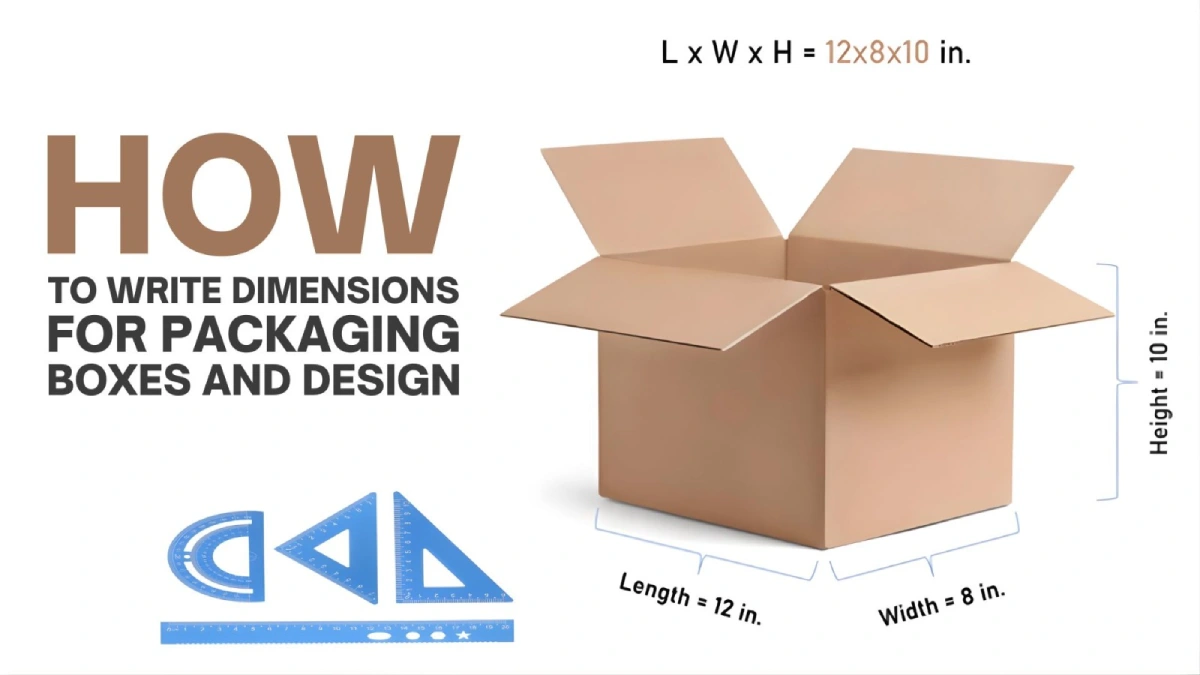
In the United States, packaging dimensions are universally written in the order Length × Width × Height (L × W × H). This is the industry standard recognized by USPS, UPS, FedEx, Amazon FBA, and virtually every packaging supplier and printer in the country.
Here’s what each measurement means in practical terms:
- Length (L) is always the longest horizontal dimension of the box when it is lying flat in its natural resting position. If you’re looking at a box on a table, length runs left to right along the longest side.
- Width (W) is the shorter horizontal dimension — the depth of the box from front to back. When the box is sitting in front of you, width measures how far back it goes.
- Height (H) is the vertical measurement — how tall the box stands when upright. This is the dimension that changes most dramatically between a flat mailer and a tall gift box.
Example to Understand: A standard shoe box might be written as 12 × 6 × 4 inches. It means it should be 12 inches long, 6 inches wide and 4 inches tall. When you write dimensions for Little Rock Packaging or any U.S. supplier, always follow this order. Reversing width and height is one of the most common errors in custom packaging requests, and it changes the entire structural design of your box.
How to Write the Dimensions of a Box: Step-by-Step Guide
Measuring an existing box correctly requires a flat ruler or tape measure and a box in its fully assembled, closed position. Never measure a collapsed or partially open box — the numbers will be inaccurate.
- Step 1: Start with the length: place your ruler along the longest side of the box’s base, measuring from one outer edge to the other. Write this number down first.
- Step 2: Next, measure the width: rotate 90 degrees and measure the shorter side of the base, again from outer edge to outer edge. This is your second number.
- Step 3: Finally, measure the height: stand your ruler vertically against the side of the box and measure from the bottom outer edge to the top outer edge. This is your third number.
One Critical Detail: Always take measurements of all the dimension of the outside unless the supplier has specified the dimensions of the inside. Inner dimensions are used to determine what is the size of material and are a bit smaller than the outer dimensions.
To design packaging and dieline design, Little Rock Packaging uses outer dimensions as the standard. If you require internal dimensions, for instance to ensure that the product will fit within an exact clearance be sure to mention this in the process of making your purchase.
U.S. Shipping Carrier Rules — USPS, UPS, and FedEx
How you write and measure your box dimensions directly affects whether your packages are accepted by carriers and what you pay to ship them. Each major U.S. carrier has specific size requirements that packaging dimensions must comply with.
- USPS determines the length and girth of a box. The girth measurement is 2x width plus 2x height. The maximum length combined with girth of Priority Mail is 108 inches. Any packages that exceed this limit are considered to be oversized.
- FedEx adheres to the same rules as UPS. When it comes to FedEx Ground, the maximum size is 165 inches if you combine length and girth. There is a the maximum length being one side.
- UPS utilizes the longest side for length measurements and calculates the girth measurement in similarly to USPS. The maximum size of the standard UPS delivery is 165 inches when you combine length and the girth. UPS also requires the use of dimensional weights on all packages.
- To be able to Amazon FBA sellers based in the USA Dimensions of the box are crucially important. Amazon has specific categories of tiers smaller standard and large standard small oversize and beyond which determine the storage costs and fulfillment rates as well as whether the product is eligible as eligible Prime shipping.
Dimensional Weight: Why Box Size Affects Shipping Cost
Dimensional weight, also called DIM weight, is one of the most important concepts in packaging for U.S. e-commerce brands and it is directly tied to how you size your boxes.
The dimensional weight formula used by UPS and FedEx in the USA is:
DIM Weight (lbs) = (Length × Width × Height) ÷ 139
If the calculated DIM weight is higher than the actual weight of the package, carriers charge you based on DIM weight — not actual weight. This means an oversized box shipping a lightweight product can cost dramatically more than a right-sized box containing the same product.
A practical example: a box measuring 18 × 14 × 10 inches has a DIM weight of 18.1 lbs. If the product inside weighs 4 lbs, you are billed for 18 lbs. Reducing that box to 14 × 10 × 8 inches brings DIM weight down to 8.1 lbs — more than halving your shipping cost with no change to the product.
Right-sizing your packaging dimensions is one of the highest-ROI decisions an e-commerce brand can make, and it starts at the custom box design stage.
Box Packaging Design Dimensions — Dielines, Bleed, and Trim
For brands working with a custom printing company like XR Packaging, dimensions go beyond the physical box — they define the entire dieline structure used to print and cut your packaging.
- A dieline is the flat, unfolded template of your box that shows every panel, fold line, glue tab, and cut edge. Dimensions feed directly into the dieline, and even a 2mm error in a submitted dimension can cause misalignment across an entire print run.
- Bleed is the extra artwork that extends beyond the cut line to ensure color or design elements run fully to the edge of the finished box with no white gaps. Standard bleed in U.S. packaging printing is 0.125 inches (⅛ inch) on all sides.
- Safe zone or margin refers to the area inside the cut line where all critical design elements — logos, text, barcodes — must sit to avoid being trimmed off. For most packaging formats, a safe zone of 0.125 to 0.25 inches inside the cut line is the industry standard.
When submitting artwork to Little Rock Packaging, always provide your dieline dimensions in inches at 300 DPI resolution in either Adobe Illustrator (AI or PDF) or a supplier-approved template format. Submitting artwork without a dieline, or with dimensions that don’t match your dieline, is one of the most common causes of production delays.
Common Dimension Mistakes to Avoid in Measuring Dimension
- Writing dimensions incorrectly can be the most common mistake. Make sure you write L W x L x H instead of H x W or another sequence.
- Inconsistency between outer and inner dimensions results in containers that may be too small to accommodate the item or are too loose to safeguard the product during transportation. Make sure you specify which measurement you are giving each time.
- The inability to determine the thickness of the board can be a problem if the fit of the inner part is crucial. A board thickness of 3mm on either side of a box indicates that the inner dimensions are 6mm less in all directions than the external. If you are dealing with products with high tolerances, this can be a problem.
- Rounding dimensions wrongly is a common issue. Rounding 11.7 inches from 11.7 to 12 inches alters the DIM weight calculation, and could cause your package to be placed in the wrong size of carrier. Take precise measurements and let the packaging provider manage the tolerances of the structural.
- Utilizing centimeters for U.S. orders creates confusion throughout the entire supply chain. Inches are the norm to all U.S. packaging, shipping as well as printing processes.
Conclusion
This guide combines the essential information that brands need to make sure their packaging is right on the first try. From reading and writing correctly dimensions of the box to gaining an understanding of U.S. carrier rules, weight of dimensional dimensions and dieline specifications.
Each section is created to eliminate confusion and avoid costly mistakes. If you follow these guidelines companies can avoid production delays, avoid shipping costs, and make sure their packaging is functioning according to the specifications.
Based on the hands-on expertise by Little Rock’s Little Rock Packaging team and evaluated through UMR (Product Designer), this book provides you with an established framework for moving from idea to production with confidence. Your packaging will does not only look good and is functional under real-world conditions.
Frequently Asked Questions
Q: What is the correct way to write box dimensions?
Always write the dimensions in the form of Length x Width Height in inches to be used in U.S. packaging. For example: 10 x 8 4 inches.
Q: What is the difference between inner and outer dimensions?
The outer dimensions represent the complete exterior dimensions of the box. The inner dimensions reflect board thickness and indicate the space that can be used inside. Be sure to specify the dimensions you are giving.
Q: How to write dimensions for packaging boxes?
Write box dimensions as Length x Width x Height, using inside measurements for accuracy. For example, a box measuring 12 x 8 x 6 inches fits products snugly inside.
Q: How do I format length, width, and height when labeling boxes?
Format as L x W x H, with length as the longest side of the opening, width next, and height from bottom to top. Always measure inside edges and note units like inches.
Q: How can I convert inches to centimeters for international packaging?
Multiply inches by 2.54 to get centimeters—for example, 10 inches equals 25.4 cm. Use this for global shipping labels to avoid customs issues.
Q: What are the standard units used for packaging box dimensions?
In the USA, inches are standard; internationally, centimeters or millimeters are common. List both if shipping abroad, like 12″ x 8″ x 6″ (30.5 x 20.3 x 15.2 cm).
Q: What does LxWxH mean in box dimension notation?
LxWxH stands for Length x Width x Height, the universal order for box sizes. Length is the longest opening side, width shorter, height vertical depth.
Q: Why do shipping companies require precise box dimensions?
Precise dimensions calculate shipping rates, ensure truck space fits, and prevent damage fees. They also help select the right box size to cut costs.
Q: Where should I place dimension labels on a packaging box?
Place LxWxH labels on the top and sides in clear, large print near barcodes. Use weatherproof stickers on the largest flat surfaces for scanners.
Q: How do packaging dimensions affect shipping cost?
Carriers like UPS and FedEx use dimensional weight pricing. A larger box increases DIM weight, which can raise your shipping cost even if the package is physically light. Right-sizing your packaging reduces this cost.
Q: What dieline format does LR Packaging accept?
Little Rock Packaging works with Adobe Illustrator files (AI/PDF) at 300 DPI. The dimensions of all images must be in inches and the artwork should have the proper bleed of 0.125 inches across all sides.
Q: Can Little Rock Packaging help me determine the right box size for my product?
Yes. LRP team collaborates with companies of all sizes throughout the USA to design customized packaging dimensions that safeguard your product, satisfy requirements for carriers, and cut down on shipping costs. Contact us today to discuss your needs.